Ancient Egypt in Watercolor: Creative Assets for Young Minds
The Allure of Child-Friendly Egyptian Imagery
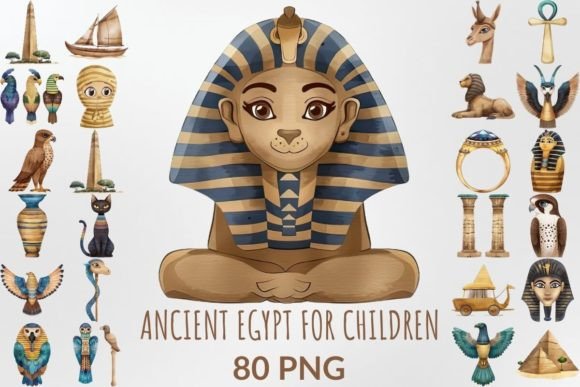
There’s a specific challenge when designing for educational or recreational content aimed at children: how to present complex historical subjects like Ancient Egypt without making them feel intimidating or overly academic. That is exactly the gap that the Watercolor Ancient Egypt for Children collection aims to fill. This bundle is not just a set of generic clipart; it is a curated suite of 80 distinct PNG illustrations. The visual style strikes a deliberate balance between historical symbolism and a soft, approachable aesthetic. By utilizing watercolor textures, the designs avoid the harsh lines often found in standard vector graphics. Instead, they offer a tactile, organic feel that resonates well with themes of nature, the Nile, and ancient craftsmanship.
The personality of this asset pack is vibrant yet gentle. It manages to capture the majesty of pharaohs and the mystery of the pyramids while maintaining a playful tone suitable for younger audiences. The illustrations cover a wide range of subjects, from the regal visage of deities to the intricate details of sacred scarab beetles. For the creative professional, this means you are getting a versatile toolkit. You are not limited to a single look; the collection spans various elements of Egyptian mythology, allowing for complex storytelling through visuals alone. Whether you are a publisher working on a children’s encyclopedia or a blogger creating educational printables, the high-resolution quality ensures that the images remain crisp across different mediums.
Strategic Applications for Designers and Entrepreneurs
Understanding the utility of these assets requires looking beyond simple decoration. In the realm of editorial design and publishing, these illustrations serve as powerful tools for visual hierarchy. A watercolor depiction of Anubis or a lotus flower can act as a focal point on a magazine cover or a chapter header, drawing the reader’s eye without overwhelming the text. Because the style is consistent throughout the 80-image set, you can maintain brand identity and visual consistency across a multi-page document or a series of social media posts. This is crucial for brand recognition, especially if you are running a thematic campaign or building a personal brand around history education.
For those in the merchandise space, specifically sublimation design, the practical value is immense. The PNG format with transparent backgrounds allows for seamless integration onto physical products. Imagine the application on children’s apparel, tote bags, or ceramic mugs. The watercolor aesthetic translates particularly well to fabric and textured surfaces, giving the final product a handmade, artisanal quality that standard digital prints often lack. Furthermore, for packaging design in the toy or educational sector, these assets can elevate a product from looking generic to bespoke. You can use them to create custom wrapping paper, stickers, or box art that immediately communicates the theme of the product.
Enhancing Digital and Print Environments
The digital landscape offers just as many opportunities. In web design, particularly for educational platforms or museum blogs, these illustrations can soften the user interface. They work exceptionally well as hero images, background textures, or iconography for navigation menus. When paired with a clean sans serif font for body text, the watercolor images provide a necessary contrast that makes the content more engaging. Conversely, when used in social media graphics, the unique style helps content stand out in a crowded feed. The "thumb-stopping" power of distinct art styles is well-documented, and the blend of history and artistry here is a strong candidate for high engagement.
It is also worth noting the value for small business owners and hobbyists. If you are creating resources for Teachers Pay Teachers or similar marketplaces, these assets are a significant time-saver. Instead of commissioning custom art, which is costly and time-consuming, you have immediate access to a library of design assets that are ready for commercial use. This allows you to scale your product offerings quickly. You could create a suite of history-themed planner stickers one week and a set of digital posters the next, all while maintaining a cohesive visual style that signals professionalism to your customers.
Technical Execution and Creative Workflow
From a technical standpoint, the compatibility of these files is a major advantage. They are designed to work with most standard graphic design software, including Adobe Photoshop, Illustrator, Canva, and Procreate. This accessibility ensures that whether you are a seasoned graphic designer or a parent making a last-minute school project, the workflow remains smooth. The high-resolution nature of the PNGs means you have flexibility in sizing. You can scale them down for a small icon on a worksheet or enlarge them for a classroom poster without significant loss of quality, provided you stay within the pixel limits.
When incorporating these illustrations into your work, consider the principles of visual hierarchy. Because these are detailed watercolors, they carry a lot of visual weight. It is often best to let the images breathe. Avoid cluttering the space around them with too many competing elements. If you are using them in editorial design, give them generous margins. If you are pairing them with typography, choose fonts that complement rather than fight the organic nature of the watercolor. A serif font with classical proportions can reinforce the historical theme, while a rounded script font can add to the whimsical, child-friendly vibe.
Ultimately, the Watercolor Ancient Egypt for Children collection is more than just a set of pictures; it is a strategic resource for visual communication. It bridges the gap between education and entertainment, offering a rich visual language that appeals to the imagination. By leveraging these assets effectively, you can enhance the perceived value of your products, create more immersive learning environments, and build a distinct visual identity that resonates with your audience. The key lies in thoughtful integration, ensuring that the art supports your message and enhances the user experience.